
European Textile & Craft Award 2026
The European Textile Academy’s award for outstanding achievement in textile craft, design, art and architecture.
An award that makes excellence visible
More and more, people consume with ecological, social and ethical concerns in mind, and all the more so as the range of products becomes more varied, cheaper and easier to access. “Better, not more” is the principle of slowing down: living and consuming more mindfully and consciously.
The European Textile Academy created the European Textile & Craft Award to honour special achievements in contemporary and traditional crafts and the arts, and their connection to the world of design. The ETA Award stands for creative, forward-looking solutions in the global market.
The international jury of leading experts recognises pioneering achievements and innovative products, taking sustainability criteria into account. The award is proof of a product’s outstanding quality and a reliable seal of quality for consumers and manufacturers alike.
Award ceremony 2026
The European Textile & Craft Awards of the European Textile Academy set international standards in honouring special achievements in contemporary and traditional crafts and the arts, and their connection to the world of design. The distinguished international jury of renowned experts only honours projects and products that are pioneering in textiles, art and craft, and highlights positive developments in circular production. The award not only makes an achievement visible, it also gives the winners access to a valuable network, international reach and new market opportunities.
A trophy by Lanificio Bottoli
In 2024, the trophy presented to the winners of the European Textile & Craft Award featured a fabric sample taken from Christo’s posthumous work in Paris: the famous wrapping of the Arc de Triomphe.
For the 2025 edition, in honour of the International Year of Glaciers, a recycled and recyclable fleece was chosen as the symbolic fabric. Lenzing had developed this innovative material to protect snow-covered mountain landscapes from the devastating effects of global warming.
Finally, the 2026 edition of the ETA Award focused on a fabric made in Italy and dyed with coffee grounds. It was developed and produced by Lanificio Bottoli, a long-established, vertically integrated textile mill in Vittorio Veneto.
“We are especially proud that the award’s organising committee chose a Lanificio Bottoli fabric as the symbol of the 2026 edition,” said the company’s president, Roberto Bottoli. “For many years we have been committed to developing fabrics that combine the highest quality, style and comfort with the search for sustainable solutions. The fabric chosen for the award also has a very special story. It is a wool fabric made without synthetic chemical additives. Its shades are created by dipping the fibres in a coffee bath, and coffee is by definition a natural and biodegradable product.”
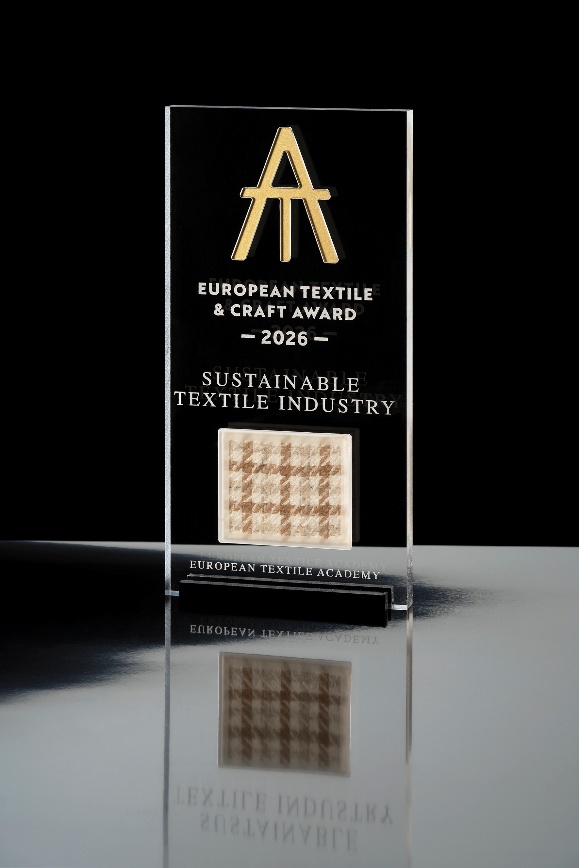
ETA Award 2026
One of the most eagerly awaited moments of the festival is the traditional presentation of the European Textile & Craft Award, held this year under the motto “When authenticity becomes style”. Numerous projects from all over the world were submitted, and the international jury faced the demanding task of choosing, from a wide variety of entries, those that stand out for originality and quality in fashion, craft, industry, art and research.
These are the winners of the 2026 edition:
The Gold Award in the Textile Craft category went to Inés Rodríguez (Spain), who makes textiles from merino wool and silk, and to Jessica Tartaglia. Since 2018, she has been producing high-quality textiles from natural fibres in her studio, Atelier Jesa, in the historic centre of Bisaccia in the Campanian hinterland.
Carlos Benny Girón Levano was named Newcomer of the Year in the Sustainable Fashion Craft category. The award recognises the development of collections with a particular focus on sustainability.
The Gold Award in the Textile Art category went to Tanja Major (Germany) for her ability to obtain paper fibres from mycelium, which she uses to make decorative objects and home accessories. Her sources of inspiration include the ancient Japanese Was(h)i technique.
The Bolzano company Alber, a well-known brand specialising in hosiery and underwear, received the award in the Sustainable Fashion Industry category. The award recognised in particular its in-house brand Filifolli, whose “Lake Como” collection draws on the heritage of the silk industry around Como and the embroidery tradition of the Varese area. It combines the distinctive feel of the fabrics with understated, subtle elegance. According to the jury, Alber’s Capsule Collection concept reflects a thoughtful approach to timeless design and high-quality craftsmanship. All pieces are made entirely in Italy.
Finally, in the Sustainable Textile Industry category, the award went to Monika and Heinz-Jürgen Gerdes. The jury honoured their commitment to reviving the wool tradition of northern Germany by processing Coastland wool.
ReSULT wins with 3D fabric for vertical gardens
Finally, the jury presented the Gold Award in the category “Textile Architecture – Research & Innovation” to the ReSULT research group at Frankfurt University of Applied Sciences. With fabricGREEN, the team has developed a modular system for green façades made from three-dimensional textiles. The structure is designed to encourage plants to grow in the spaces within the fabric. The project opens up new perspectives for climate-resilient architecture. The patented system serves as a substrate in which roots can settle and grow, while also allowing an efficient water supply.
The system consists of lightweight, prefabricated and pre-planted modules that can easily be mounted on the vertical structures of buildings. The Frankfurt researchers’ project is a fine example of how a textile structure can take on innovative technical functions. In this case, the textile technology helps to improve the microclimate in cities.
Take part in the European Textile & Craft Award
Everything you need to know for your submission. Dates and registration are shown right away; all other points can be expanded.
Dates
- Registration and submission: by 20 September 2025
- Jury meetings: October and November 2025
- Announcement of the winners: December 2025
- Gala award ceremony: Friday, 23 January 2026, at the Waltherhaus in Bolzano
The winning projects will be exhibited in the Winner Gallery at the International Festival of Textile Craft, Textile Art & Design from 20 to 22 March 2026 at Maretsch Castle in Bolzano.
Key values in focus
The materials used and innovative natural fibres, aesthetic and functional design, quality of workmanship and use of resources, environmentally friendly production and social and ethical aspects are essential criteria for the award.
Textile ecology criteria
Textile ecology is a young field, but in view of scarce resources, rapid population growth and the use of chemicals and energy, it is becoming dramatically more important and poses major challenges for the textile industry and for consumer behaviour. In this context, the jury assesses solutions to the problems that arise worldwide for people and the environment in the extraction, processing, finishing, making-up and transport of textile raw materials and structures, from the finished product on the market all the way to disposal and recycling.
Sustainable processes and products
- Fibres and materials from organic farming
- Traditional materials produced with gentle technologies and processes
- Manufacturing processes with low energy and water consumption
- Sustainable business management
- Animal fibres and materials must come from humane animal husbandry and from processes that do not involve cruel techniques.
- Materials from responsibly managed forests
- Manufacturing processes without hazardous chemicals
- Innovative bio-based man-made fibres
- Man-made fibres from closed-loop processes
- Recycled materials
Benefits of the award
Winning a European Textile & Craft Award attracts attention and increases your visibility. The ETA Award 2026 is proof of a product’s outstanding quality and a reliable seal of quality for manufacturers and customers.
- The winners become part of a unique community and make interesting and valuable contacts.
- The ETA Award is unique in this sector and, thanks to its expertise, enjoys the highest recognition.
- The winners receive the “ETA Award” sculpture.
- The winners receive two copies of a high-quality award certificate.
- The ETA Award is widely publicised in print, online and on social media and achieves maximum reach. Key steps, from the jury meeting to the award ceremony, are shared on social media.
- The winners receive award labels for their corporate communication.
- The winning entries are published permanently in the online gallery, with a link to the award-winning company.
- The jury provides all winners with a short statement explaining its decision. It is published in the online gallery and at presentations.
- The winning projects and products will be exhibited at the International Festival of Textile Craft, Textile Art & Design from 20 to 22 March 2026 at Maretsch Castle in Bolzano.
Submission and nomination
Apply for the European Textile & Craft Award 2026 and convince the jury that your work deserves to be recognised and honoured. The award is open to manufacturers, designers, craftspeople, artists, architects, universities and research institutions, museums, collectors, archives, hotels and restaurants. Registration for the award is only possible via the European Textile Academy’s registration form.
When submitting, please include the following on the registration form:
- Company address, the manufacturer’s website and contact persons.
- Description of the activity and the product (max. 500 characters, de/it/en).
- Discipline or category. If your product does not fit any of the listed subcategories, please select “Other” here.
- Where possible, please submit the product presentation in hybrid form. This means you send us an original product, sample, fabric quality, etc., plus additional digital presentation material for judging. In some categories, it is possible to submit digital presentation material only.
- Once we have received your registration, you will receive the invoice for your participation.
The following file formats are accepted as digital material and should be sent via WeTransfer:
- Up to 10 images as JPG, max. 10.1 MB each.
- Up to 5 videos as MP4 or MPG, max. 1.4 GB each, recommended length: 2 min.
- Up to 5 PDF files, max. 10 pages and 54.6 MB each, 96 dpi.
Please note that the presentation material and description cannot be added to or edited once registration is complete. Make sure all materials are complete and correct before you finish your registration.
After you register, our team of experts will review your submission carefully. You will then be informed in writing whether your submission meets the required criteria and has been nominated for the ETA Award 2026. If it is not admitted, you will also be notified.
Evaluation by the jury
In each category, the jury selects “Award” winners and an appropriate number of “Silver” winners. In addition, “Special Mention” distinctions are given for particularly noteworthy achievements.
Assessment criteria:
- Overall concept
- Aesthetic and functional design
- Quality of workmanship
- Materials or fibres used
- Sustainability
The order does not represent a ranking. The jury is free to weight the individual criteria. All applications submitted in the correct form and on time are presented to the jury for judging.
Fields and categories
You can take part in the European Textile & Craft Award in the following award fields. You can enter your application in one category each, whichever suits you best.
- Textile Craft
Textile crafts such as weaving, dyeing, knitting, embroidery, upholstery, textile printing, millinery and more - Sustainable Fashion Craft
Fashion craft, bespoke tailoring - Sustainable Fashion & Textile Industry
Sustainable industrial production in women’s and men’s fashion and in the textile industry - Textile Art
Textile art, exhibition installations and more - Textile Architecture
Textile structures with membranes and cables. Architecture of buildings of all kinds (public buildings, sports venues, industrial and corporate buildings, homes, museums, hotels and more) - Textile Shading Systems
Textile shading systems, tent structures and more - Architecture with Natural Fibres
Contemporary architecture with fibres such as hemp, flax, straw, bamboo, willow, bark and renewable plant fibres. Natural fibres have many extraordinary ecological and aesthetic qualities as building materials of the future. - Interior
Home textiles and carpets, upholstered furniture, upholstered beds and home accessories, textile printing, indoor and outdoor - Hospitality
The award honours hotels, inns and restaurants that have recognised the quality of textile furnishings in all guest areas as a competitive advantage. - Museums, Collections & Archives
The award aims to honour outstanding work by museums, collections and archives, the quality of museum presentation and education, and efforts to preserve “textiles” in all their forms as cultural heritage and make them accessible to a wide public. - Other
Textile fields not covered by the categories above. Registration on request.
Participation fees
- Textile Craft: €350.00
- Sustainable Fashion Craft: €350.00
- Sustainable Fashion & Textile Industry: €700.00
- Textile Architecture: €700.00
- Textile Shading Systems: €700.00
- Architecture with Natural Fibres: €700.00
- Interior: €700.00
- Hospitality: €700.00
- Museums, Collections & Archives: €350.00
- Other: on request
The participation fees apply per submitted project, plus VAT at the statutory rate. The ETA gala award ceremony will take place on 23 January 2026 (subject to change) at the Waltherhaus in Bolzano. Tickets for the event can be booked via the European Textile Academy’s ticket portal.
Please note that attending the award ceremony involves additional travel and accommodation costs. These costs are not included in the participation fee. The participation fee for the selection process is non-refundable once processing of applications has begun, including if your entry is not nominated.
Registration and information sheet
Registration is only possible via the European Textile Academy’s registration form. You will also find all the details about the award in the information sheet.
Jury panel
The European Textile & Craft Award is decided by an independent international jury of experts from colleges, universities, craft and industry, art and culture.
Former CEO of ESCADA for Italy and France, previously marketing director for brands such as Moschino, Alberta Ferretti and Jean Paul Gaultier. Founder of San Lorenzo Lodges and an ambassador of Italian style.
Owner of the Antonella Cattani contemporary art gallery in Bolzano since 1991. Presents internationally renowned and emerging artists in exhibitions and at art fairs in Italy and abroad.
Award-winning textile innovator and founder of Jennifer Daley Fine Textiles. Develops high-performance textiles from animal protein fibres such as wool. Runs the Daley Textile House and Gardens near San Francisco.
Over 25 years of experience in textile architecture. International project developer and expert consultant. Focus on natural fibres and technical textiles. Speaker, author and workshop leader.
Architect and partner at METAFORM Architects, with offices in Luxembourg and Dubai. Works at the interface of design and architecture. His projects include the Luxembourg Pavilion at EXPO 2020 Dubai. Lecturer, founder of the magazine Adato and member of numerous juries.
President of Blumine srl, a research and consultancy firm for sustainable textiles and fashion. Lecturer at LIUC University and author of numerous articles on sustainability.
Danish designer based in Copenhagen. Works at the intersection of art and design, creating limited-edition pieces from bio-based materials such as straw, wood, plant fibres, clay and stone.
Architect specialising in lightweight textile structures, with a doctorate from the University of Duisburg-Essen. Has led the TEXTILE-ARCHITEKTUR network since 2009 and organises trade fairs and symposia.
Costume designer and lecturer in costume history at the Akademie Design AMD. Member of ICOM Costume and Netzwerk Mode Textil. Regularly publishes and gives talks on textile topics.
Italian curator of design and applied arts. Founder of Schloss Hollenegg for Design in Austria. Her exhibitions include shows at the MAK Vienna, the Venice Biennale and the Salone del Mobile in Milan.
Cultural and project manager, head of the Leopold Kohr Academy in Salzburg and Neukirchen. Organises lectures, exhibitions, symposia and events. Publishing director of TAURISKA.
Managing director of the communications agency Silent Communications and publisher of Silent Luxury magazine. Reports on quality, sustainability and traditional craftsmanship in the textile and fashion industry.
Designer and textile historian. Lecturer in textile design at the Liceo Artistico Guggenheim in Venice and curator of the Rubelli company archive. Numerous publications on textile collections.
Questions about the award?
Not sure which category suits your project, or have questions about your submission? We will be happy to help.